

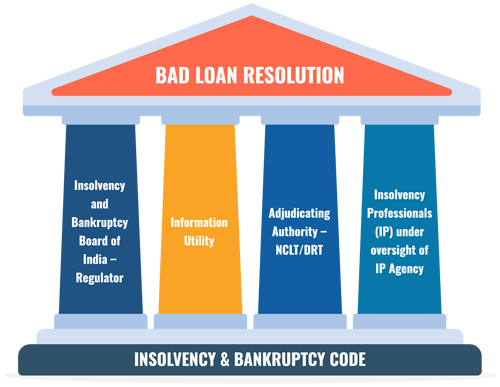

The Information Utility constitutes a key pillar of the insolvency and bankruptcy ecosystem of India, the other three being the Adjudicating Authority (National Company Law Tribunal and Debt Recovery Tribunal), the Insolvency and Bankruptcy Board of India (IBBI) and Insolvency Professionals (IPs).
The IU is designed to bring transparency and reliability to financial information within the insolvency ecosystem. It serves as a centralized, regulated, neutral repository that collects, authenticates, stores, and provides access to data relating to debt, default, and security interests of borrowers.
Information Utility is an institution with the following objectives:

To provide undisputed information for initiation of insolvency process

To serve as a credit and contract repository

To accept financial information from financial or operational creditors or debtors themselves

Such financial information accepted will be sent for authentication to all the parties of the debt and stored for use as evidence in any legal process

To act as a two-way communication tool between creditors and debtors for submission and authentication with a provision to record disputes

This is a cost-effective tool to prove identity of the borrower, borrowing, security interest and default
To provide undisputed information for initiation of insolvency process
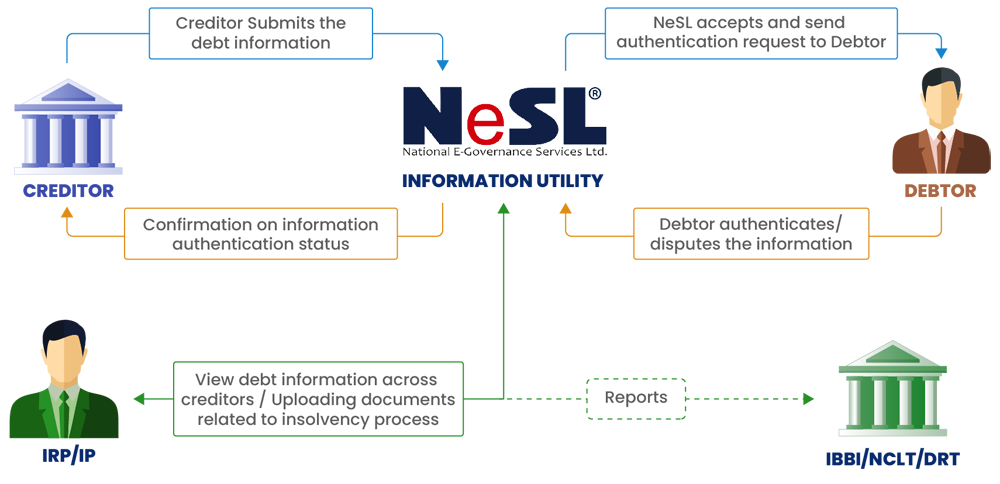
The working of an Information Utility (IU) happens through a systematic collection, verification, storage, and dissemination of financial information related to debt and default. When a financial creditor such as a bank, NBFC, financial institution or an operational creditor such as a vendor, supplier of goods or services submits details of a transaction (financial information) or information of default to the IU, the system send an intimation email, primarily to the debtor, seeking confirmation of the data. This process of authentication ensures that both sides agree on the accuracy of the information recorded.
If the debtor validates the submission, the information becomes ‘Authenticated’; if the debtor does not respond within the stipulated time, it is treated as ‘deemed to be authenticated’ (Except for submissions by creditors who are part of the Schedule II of the Reserve Bank of India (RBI) Act, 1934. For creditors in this category, even if there is no response from the parties to the debt, it will still be categorized as ‘Authenticated’).
If the debtor does not agree to the information submitted by the debtor, there is an option to ‘Dispute’ the information along with an option to upload the supporting documents in this regard.
All such records are maintained in a secure electronic database, where each submission is digitally signed and time-stamped to preserve data integrity. The IU then provides controlled access to this authenticated data to stakeholders basis explicit consent.
Through this structured mechanism, the IU ensures that financial information is reliable, tamper-proof, and easily retrievable, thereby supporting quicker insolvency resolution and greater transparency in credit and default management.
NeSL is India’s first Information Utility and is registered with the Insolvency and Bankruptcy Board of India (IBBI) under the provisions of the Insolvency and Bankruptcy Code, 2016 (IBC).
Copyright © 2026. This is the Official Website of the National E-Governance Services Ltd. All rights reserved